How can you teach animal structures and functions in fourth grade? To make it more manageable, focus on one class, or group. Since birds have so many adaptations, they make a great choice.

Posts on this website follow a teaching journey and are written in story form.
Ms. Sneed Plans for Teaching Animal Structures in Fourth Grade
Our favorite fourth grade teacher, Ms. Sneed, clicked away on her laptop. Recently, her class explored plants. Now they would dive into animal structures.
“Ready to plan the next portion of our life science unit?” she asked her teaching partner.
“Yep,” replied Mr. Frank. “Bring it on. If I remember correctly, last year our students used a jigsaw project to learn about animal adaptations.”
“You read my mind.” Ms. Sneed turned her laptop so Mr. Frank could see.
Exploring Animal Structures and Functions
“Each child begins with one of four general animal structures and their functions: beaks, feet, wings, or body systems.”

Responding to the Text
“Then they use these response sheets to show what they’ve learned about the animal structures and functions.”

Focusing on One Adaptation
“Next,” Ms. Sneed continued, “they read another passage about a specific type of bird adaptation and its function. The resource includes 27 different informational texts.”
Mr. Frank nodded. “Essentially, each child becomes an expert on one adaptation of one animal structure.”

Fourth Grade Students Share Animal Structures and Adaptation
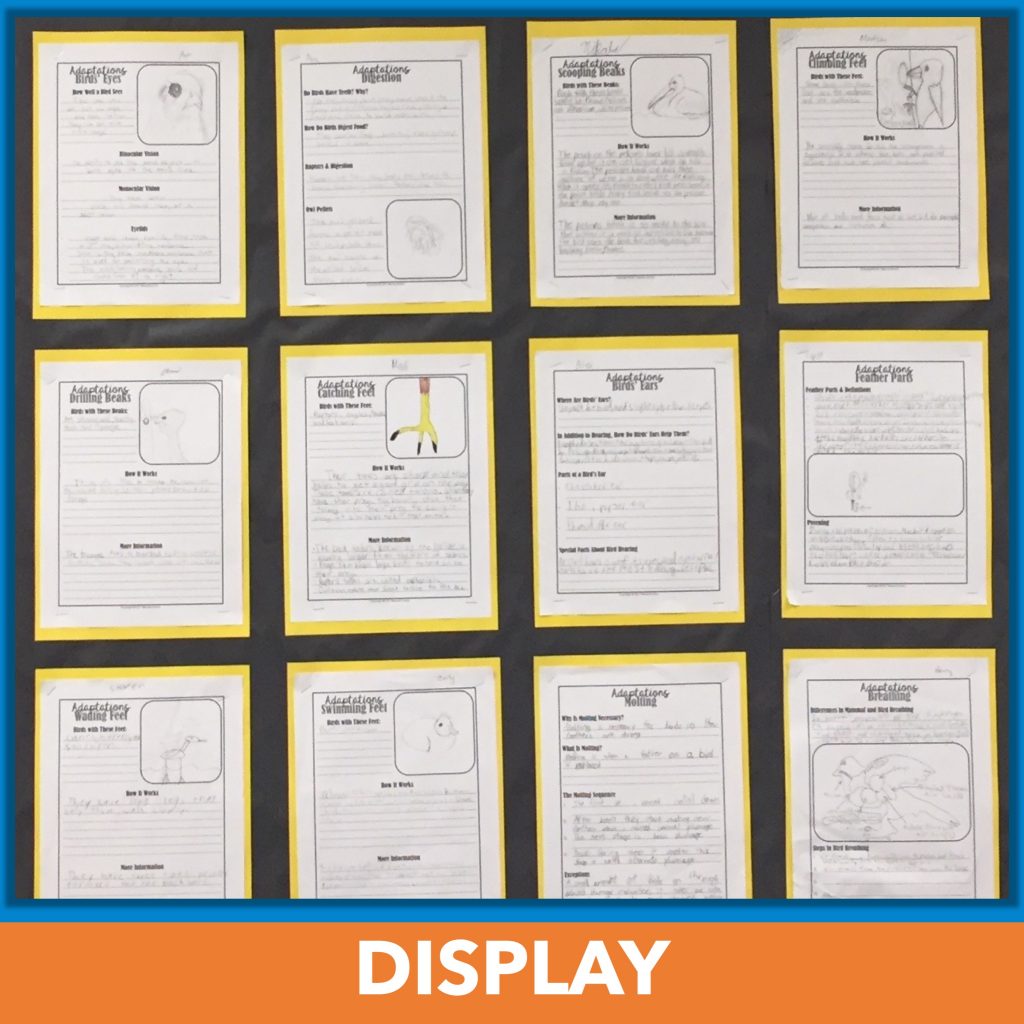
“Correct,” Ms. Sneed replied. “They also create a poster to explain the animal structure. Afterward, we display the posters. Then everyone learns from them.”

“What if we were to extend this a bit?” asked Mr. Frank. “In my class, I think I’ll have each student make a one-minute presentation. You know, to hit the highlights. Then we can follow up with our bird beak lab.”
“Great idea! More engagement, more integration with ELA, and more learning!” Suddenly, Ms. Sneed paused. “Remember that cool video that showed how birds fly? Without a doubt, our kids need to see it.”
“Yeah, and we can also share the link for that bird migration app.”
Animal Structures and Functions Website
“To save paper,” said Ms. Sneed, “we can use the bird adaptations website. That way, kids can access the information online.”

Writing Project
“Let’s not forget the writing project,” said Mr. Frank.
“Right. Our students can write one- or five-paragraph essays to explain how animal structures support survival. That covers an important science standard – and gives our kids some practice writing informational texts.”
The two teachers grinned at each other. Once again, a great set of lessons!