
Yes, hands-on sound lesson plans can be quick and easy! When you use stations, the entire unit can be completed in five days. With a corresponding STEM activity, you can extend it to seven days or more.

Posts on this website follow a teaching journey and are written in story form.
Ms. Sneed Prepares Sound Lesson Plans
Our favorite fourth grade teacher sat at the side table with her teaching partner. As she scrolled through their sound unit, she asked, “Hmm, how much time should we spend on this?”
Mr. Frank opened his laptop. “Let’s see if we can squeeze it into the time we have. Maybe one or two weeks? I’ll type the sound lesson plans while you talk me through the activities.”
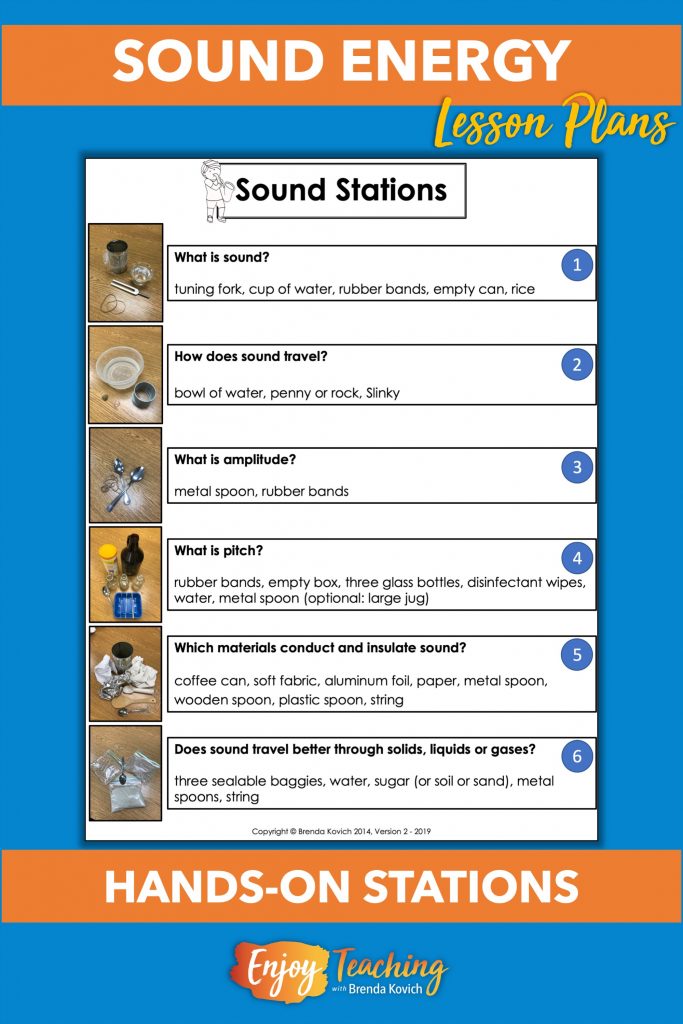
“Hmm,” Ms. Sneed responded, “the unit includes six sets of hands-on activities. Let me review them:
- What Is Sound? In this set, kids strike tuning forks on their shoes then listen. They also watch as noise makes rice on plastic dance and pluck rubber bands. This helps them discover that sound is a vibration.
- How Does Sound Travel? Simple activities like clapping their hands in front, behind and about them help kids understand that sound waves spread out in all directions. Additionally, they play with Slinkys and drop pennies in water.
- What Is Amplitude? With more clapping and plucking, kids find that more force means louder noise, or greater amplitude of sound waves.
- What Is Pitch? Again, kids pluck rubber bands – this time wide and narrow. In addition, they experiment with waters containing different amounts of water. Here, they discover that longer waves have lower pitch.
- Which Materials Conduct and Insulate Sound? Using a large metal can, students investigate how different materials act as conductors or insulators of sound.
- Does Sound Travel Better Through Solid, Liquid, or Gas? First, kids tap the table while holding their heads on bags filled with air. Then they try bags with water and sand. Surprisingly, the solid conducts sound best.
5-Day Sound Lesson Plans
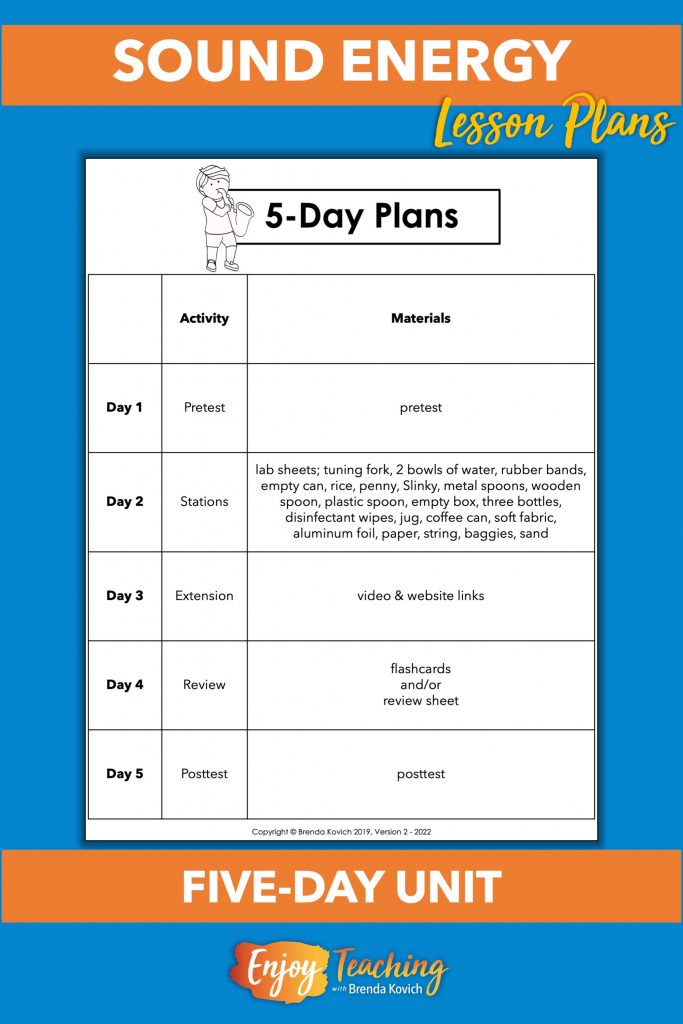
“If we use the sound activities as stations, we can definitely make our sound lesson plans for five days,” Ms. Sneed told Mr. Frank. “Then we’ll have time for all of our physical science activities.”
“On the first administer the pretest on the first day. I like to compare their understanding before and after the unit.”
“Then on the second day, we can do the activities as stations. Students will spend ten or fifteen minutes at each center. At each, they’ll make generalizations to discover energy concepts on their own.”
“The following day, we’ll use videos to reinforce their findings,” Ms. Sneed said.
“And get rid of any misconceptions,” added her teaching partner.
Ms. Sneed nodded. “Next, we’ll use the flashcards and review sheet to review vocabulary and concepts.”
“Although it’s a quick turnaround, I feel that they’ll be ready for the final assessment on the fifth day.”
Mr. Frank stopped typing. “Sure is fast. But I agree that they’ll be ready.”
Adding a STEM Activity
“If we’d like to add an engineering design component, we can add a STEM activity to our sound lesson plans,” Ms. Sneed said.
“Ah yes, I remember that challenge.” Mr. Frank smiled. “Sure! Let’s do it! Our kids will have fun designing musical instruments that produce high, medium, and low sounds.”
Ms. Sneed stood up and walked to the science cabinet. After rustling around, she found what she was looking for. “Thankfully, I saved the materials from last year:
- toilet paper tubes,
- straws,
- rubber bands,
- craft sticks,
- string, and
- a variety of metal screws
Soon, she was smiling too. “Our kids will love this!”

7-Day Sound Lesson Plans
“We’ll stick it in before the review and posttest. To do it justice, I think we should spend at least two days on it.”
“Perfect!” exclaimed Mr. Frank. “I’m done typing. We’ll just print these seven-day sound lesson plans. I can’t wait to get started on this.”

Enjoy Teaching
Ms. Sneed sat back in her chair with a satisfied look on her face. Yes, these sound lesson plans were quick, but they would do the trick. Not only that, hands-on learning made her enjoy teaching so much more. Try it, you’ll like it!


